


Idle Outpost: Upgrade Games
4.55.02K Reviews
App Specs
- Version
- 2.1.5
- Updated On
- License
- Free
- Downloads
- 10,000,000+
- Developer
- AppQuantum
- Categories
- Simulation
- Platform
- Android, iOS
Screenshots



 Analysis by AppCompare
I’ve been playing Idle Outpost: Upgrade Games in short bursts, and it makes most sense to me as a shared-room game rather than something that needs a long, uninterrupted session. One person can check the outpost while waiting for dinner, then hand the device to someone else to look at the upgrades or see what has changed. That casual rhythm is part of the appeal: the game gives you a reason to return without demanding that everyone in the household sit down for a full strategy session.
That said, I’d treat a shared device as belonging to one player at a time. The outpost’s progress is personal in practice, and passing a device around does not automatically make it a cooperative game. If different family members want separate progress, agree on whose turn it is before starting and avoid making upgrades on someone else’s run without asking. That small boundary prevents the most common shared-device frustration: returning to find that a resource was spent in a way you would not have chosen.
Short visits work best when you have a plan
A useful routine is to open the game with one clear task in mind: collect what has accumulated, check what the next upgrade needs, and decide whether to spend now or wait. It keeps a quick visit quick. If you open it without a goal, the steady succession of things to improve can turn a spare minute into a longer session, especially when you start comparing several possible upgrades.
For example, on a weekday commute break, I’d check the outpost, make one upgrade decision, and leave the next step for later. In the evening, I might take more time to consider how that choice affects the next bottleneck. This approach suits the idle format better than repeatedly checking the screen whenever you have a few seconds. It also makes progress feel deliberate rather than like a string of taps.
There is a trade-off here. Idle progress is convenient, but it can make the game feel less urgent than a hands-on strategy title. If you want every moment to depend on quick reactions or precise combat input, this is not the kind of simulation I’d choose. Its satisfaction comes more from planning improvements and watching a base become more capable than from mastering demanding controls.
First Impressions
From the moment you fire up Idle Outpost: Upgrade Games, you’re greeted with a vibrant, colorful interface that’s both engaging and easy on the eyes. The game doesn’t throw you in the deep end; instead, it eases you into the action with a quick tutorial that’s as friendly as it is informative. I appreciated this, especially since some strategy games can feel overwhelming right off the bat.
The premise is simple yet addictive: you’re tasked with building and upgrading your outpost, gathering resources, and defending against enemies. It’s the kind of game that you can pick up for a few minutes at a time, but it’s also easy to get sucked in for hours if you’re not careful!
Worth Reading Before You Choose

EA SPORTS FC Mobile 26 Is a Bigger Football Game, but It Takes Time

Flipboard Shows What News Apps Must Do Beyond the Feed

Switching to Android Auto Means Rethinking Your Driving Routine

Google Calendar Makes a Crowded Week Easier to Manage

Ludo King Makes the Most of the Minutes Between Plans

Baby Panda World Brings Quick Play to Modern Phones, but Its Game Library Feels Busy
Gameplay Mechanics
Let’s dive into the mechanics. At its core, the game is all about resource management and strategic upgrades. You start with a basic outpost, and your goal is to expand and enhance your operations. This is done by collecting resources, which you can then use to upgrade various aspects of your base. The upgrade path is quite satisfying, with each improvement making a noticeable impact on your efficiency and capacity.
One thing I really liked is the idle aspect. Even when you’re not actively playing, your outpost continues to function, gathering resources and making progress. It’s a fantastic feature for those of us who have busy schedules but still want to enjoy a sense of progression.
Strategic Elements
Now, let’s talk strategy. As you progress, you’ll encounter various challenges and enemies that require careful planning. The game encourages you to think about which upgrades to prioritize and when to do so. This added layer of strategy keeps things interesting and ensures that you’re always thinking a few steps ahead.
There are also missions and events that pop up, offering rewards and bonuses for completion. These add a nice variety to the gameplay and give you short-term goals to work towards, in addition to the overall progression of your outpost.
Make upgrade choices around your bottlenecks
One practical tip is to notice what is slowing your next useful improvement, rather than spending resources simply because an upgrade is available. If a particular resource or capacity is holding you back, prioritizing the relevant improvement can make the next visit more productive. I would also pause before using a reward immediately: a bonus is most valuable when it helps clear a real obstacle, not just when it makes a number rise on screen.
This is where the game’s strategy differs from a more traditional base-building simulation. The outpost develops through a fairly approachable upgrade loop, so the interesting choice is often about timing and priorities rather than designing a complex layout or managing many interacting systems. That makes it easier to enjoy casually, but players who want deep construction choices or intricate tactical control may prefer a more demanding strategy game.
When missions or events appear, I’d treat them as optional short-term direction rather than a reason to abandon every other plan. They can give a useful target when the main progression feels open-ended, but chasing every task at once can make a relaxed idle game feel like a checklist. I find it more satisfying to choose a goal that fits the time I have and return to the longer upgrade path afterward.
What to expect from the business model
The game is free to play, with in-app purchases ranging from $0.99 to $250.00 per item. That broad range is worth keeping in mind if the device is shared with children or if purchases are a concern in your household. I would make the household rule clear before handing over the device: gameplay can be shared, but spending decisions belong to the account owner and should not be made casually during play.
For a relaxed player, I would start by seeing how the ordinary progression feels before considering any purchase. The core loop is built around accumulating resources and choosing upgrades, so patience is a reasonable alternative to paying to move faster. If someone in the household dislikes waiting or feels pushed to buy whenever progress slows, that is a sign this particular idle format may not be enjoyable for them.
Visuals and Sound
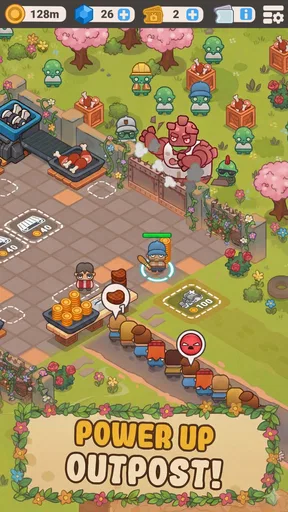
On the visual front, Idle Outpost: Upgrade Games is a treat. The graphics are crisp and vibrant, with a style that’s both charming and functional. Each element is designed with clarity in mind, ensuring that you’re never confused about what’s happening on screen.
The sound design complements the visuals perfectly. The background music is soothing yet engaging, providing a pleasant backdrop as you manage your outpost. Sound effects are subtle but effective, adding to the overall immersion without becoming overwhelming.
Age, trust, and who should play
The game is rated for Everyone, which makes it broadly suitable for a household audience, but an age label is not a substitute for a quick look at how a particular child responds to a game. I’d pay attention to whether the repeated upgrade prompts and optional purchases feel fun or distracting to them. For younger players, a parent can help set a simple rule about asking before buying and avoid turning the game into a competition over who advances fastest.
Because the game is an idle simulation, it can be a comfortable introduction for someone who likes building and gradual progress but has little experience with strategy games. It is also a good fit for adults who want a light game to revisit between other tasks. I would skip it for anyone who needs a strong narrative, a clearly finished campaign, or a game where every session brings a major change; the appeal here is the continuing process of improving the outpost.
If you are deciding whether it will work on an older device, the minimum requirement is Android 6.0. The current version is 1.26.8, and AppQuantum is the developer. The game has a 4.7 average from around 148 thousand ratings, with over 10 million installs. Those figures show that it has found a large audience, but they do not tell you whether its relaxed pace matches your taste, so I’d judge it by the loop itself: collect, weigh an upgrade, and return later.
Final Thoughts
So, is Idle Outpost: Upgrade Games worth your time? In my opinion, absolutely. It’s a delightful mix of strategy, resource management, and idle gameplay that’s both accessible and rewarding. Whether you’re a seasoned strategy fan or new to the genre, there’s something here for everyone.
With its engaging mechanics, charming visuals, and strategic depth, this game has certainly carved out a spot on my list of favorites. If you’re ready to take on the challenge, I’d say give it a shot and see how far you can take your outpost!
A sensible household verdict
For a family or shared-device setting, I’d recommend it when everyone is comfortable taking turns with one continuing outpost and when the person responsible for the account is happy to keep purchase decisions in their hands. It works especially well as a casual check-in game: one player can make a considered upgrade, while another can simply enjoy seeing the settlement develop. The key is to agree on who controls progress, rather than assuming that several people can independently manage the same save.
I would choose a different game if your household wants genuine teamwork, separate player identities, or a more involved simulation with detailed planning at every step. Idle play is the central attraction here, and it is also the main limitation: the game can feel repetitive if gradual upgrades do not hold your interest. But if a colorful post-apocalyptic setting, manageable strategy decisions, and progress between short visits sound appealing, this is an easy game to try without paying upfront. It’s best enjoyed as a low-pressure outpost to tend, not as a demanding strategy challenge.
Pros
- Engaging gameplay with strategic depth.
- User-friendly interface for easy navigation.
- Regular updates with new content.
- Visually appealing graphics and design.
- Offline mode available for on-the-go play.
Cons
- In-app purchases can be costly.
- May feel repetitive over time.
- Requires internet for some features.
- Occasional lag on older devices.
- Ads can be intrusive at times.
FAQs for Idle Outpost: Upgrade Games
What is the main objective of Idle Outpost: Upgrade Games?
Idle Outpost: Upgrade Games is a strategic simulation game where players aim to build and upgrade their outpost. The primary goal is to manage resources efficiently, expand your base, and enhance your defenses against potential threats. Players must strategize the best upgrades to maximize growth and secure their outpost.
How do the upgrade mechanics work in Idle Outpost?
Upgrades in Idle Outpost are essential for progressing through the game. Players earn resources over time, which can be invested into various aspects of their outpost, such as buildings, defenses, and technologies. Each upgrade improves efficiency or power, and strategic planning is required to optimize resource allocation for the best results.
Does Idle Outpost require constant internet connectivity?
Idle Outpost is primarily an offline game, allowing players to enjoy most features without an internet connection. However, certain aspects, like leaderboards and special events, may require online access. This makes it convenient for on-the-go play, while still offering additional features when connected.
Are there any in-app purchases in Idle Outpost: Upgrade Games?
Yes, Idle Outpost offers in-app purchases that can enhance gameplay. Players can buy resources, special upgrades, or speed up progress. While these purchases can accelerate your experience, the game is designed to be fully playable without spending money, ensuring a fair experience for all players.
What makes Idle Outpost different from other idle games?
Idle Outpost stands out with its detailed strategic elements and immersive gameplay. Unlike typical idle games, it requires players to make thoughtful decisions about upgrades and resource management. The game also features a unique setting and storyline, providing an engaging experience that keeps players invested for the long haul.


